Moving TVs and mirrors without their original boxes
The original television box is long gone, and the hallway mirror never had one. Both can still be assessed for your move, but the packaging needs to suit the actual item before collection is arranged.
Use this guide to prepare the model details, measurements and photographs Interstate Removalists Co needs to discuss suitable protection, handling and delivery with you.
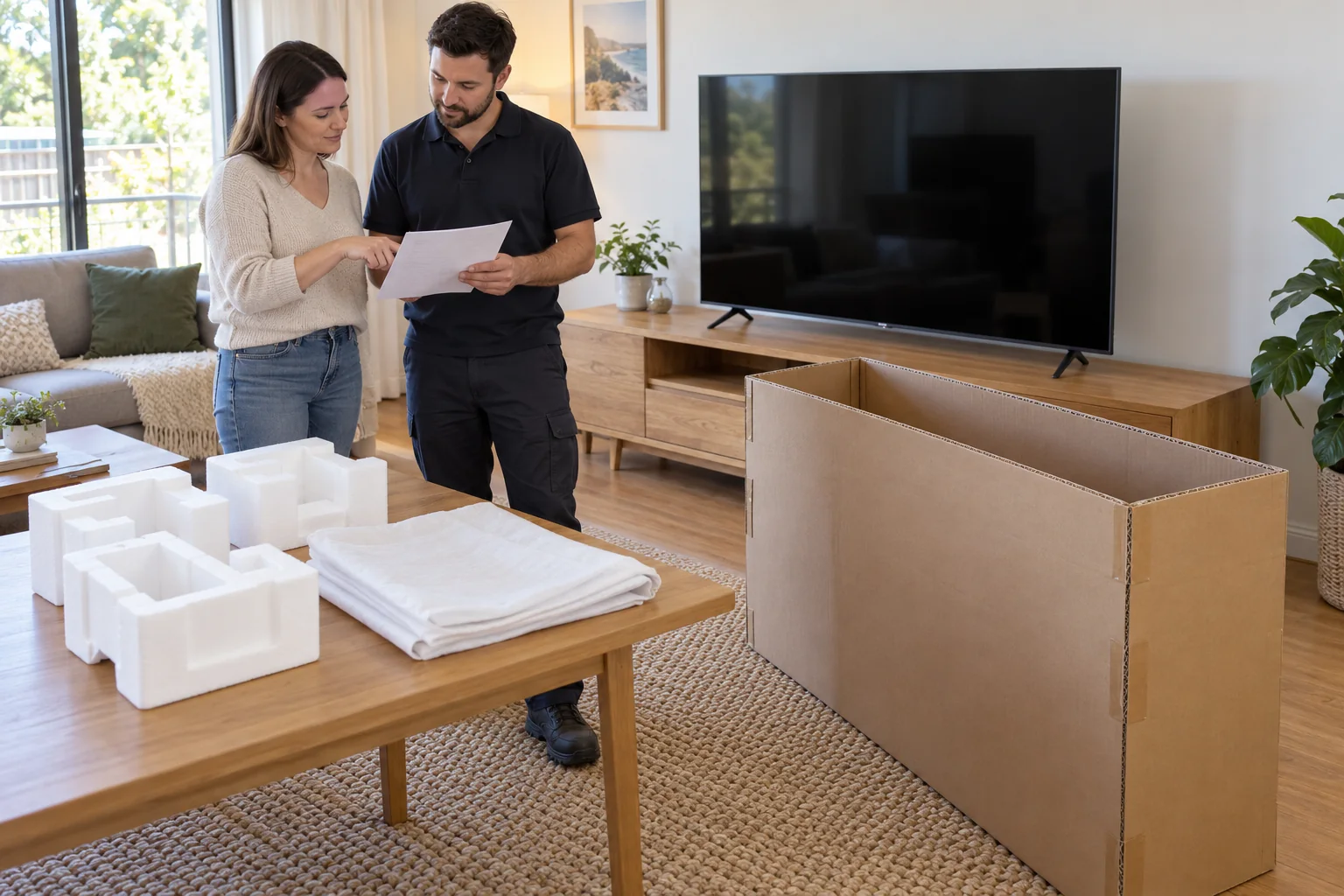
Start with the item, then choose its packaging
A “65-inch TV” or “large mirror” is a starting point for an inventory, but it does not tell the packer what needs supporting. The television’s screen size is measured diagonally. The mirror may have a strong timber frame, exposed glass edges or delicate decoration. Those differences affect the preparation.
Give each item a simple code, such as TV1 or M1, and use it on your photographs and enquiry. Include the overall dimensions, known weight, condition, current position and destination room. For the television, add the full model number and a link to its manufacturer’s instructions if available.
Ask IRCO to assess the packing and handling with your furniture transport. Include whether the item is upstairs, wall-mounted or going into storage. Getting those details together early gives us a clearer picture than a photograph of the front alone.
Before you buy a replacement box: check the item’s actual dimensions, the packaging limits and the protection required inside it. An empty carton that looks large enough may still be unsuitable once the correct supports are fitted.
Check the complete replacement packaging system
Think about three jobs: protecting the surface, supporting the item without harmful pressure, and protecting the package during handling. A soft cover may address surface contact, but it does not perform all three jobs. The carton, inserts and item need to work together.
| Item | Information to provide | Decision to confirm |
|---|---|---|
| Flat-screen television | Exact model, width, height, depth, weight and stand configuration | Compatible carton and inserts, surface protection and handling instructions |
| OLED, curved or unusually large TV | Panel design, projecting parts and manufacturer’s support points | Whether standard replacement packaging is suitable or another arrangement is needed |
| Plain framed mirror | Overall dimensions, frame depth, backing and condition | Appropriate frame support, corner protection and outer carton |
| Frameless, ornate or heavy mirror | Exposed edges, decoration, weight and mounting method | Specialist assessment, removal method and possible custom protection |
Use the supplier’s instructions for the exact replacement kit. For example, U-Haul’s TV-kit assembly guide shows a system with adjustable carton sections and fitted foam pieces. Those parts are intended to work together; another carton may have different limits and assembly steps.
Australian supplier MoveinBoxes also explains measuring a television for its moving box. Check both the outer set dimensions and the room required by the selected protection. Do not trim or compress inserts simply to force a mismatch to fit.
If you have kept an old carton, describe its condition and whether all its inserts remain. Packaging from a different television is not automatically compatible. Send photos before spending time adapting it or presenting it as ready for collection.
Prepare the television in the right order
Record the working setup before disconnecting it
While the TV is safely in its normal position, photograph its condition and note any existing marks or faults. Record the model number from the settings menu or accessible label; do not reach behind an unstable set to find it. Photograph cable connections if that will help you reconnect the equipment later.
Make a short accessories list: remote, power lead, external power supply, stand or feet, mounting fittings and any separate connection unit. Label both ends of removable cables where useful. Keep accessories in a separate protected package linked to TV1, rather than loose inside the screen carton.
Agree wall removal and stand preparation
Tell the office whether the TV is on a cabinet or attached to the wall. Confirm who will remove it, who will prepare the stand or bracket components, and when that work happens. Concealed cabling, unfamiliar fixings or installation work may require a separate suitable technician.
Find the instructions for the exact model through the manufacturer, such as Sony’s product support and manuals. The permitted hand positions, number of people and stand-removal sequence can differ. Keep the television stable until the people, work surface and packaging required for that sequence are ready.
Switch off and disconnect equipment as directed before moving it. Follow the manufacturer’s cleaning guidance if preparation includes cleaning; do not add a last-minute coating, adhesive film or cleaning product that has not been checked for the screen.
Protect the panel without squeezing it
Screen-contact materials must suit the model. Keep tape and adhesive labels off the display and finished surfaces. Avoid loose hardware, grit or other hard objects inside the protective layers. The packing arrangement must support the television at appropriate points without using the screen as a bearing surface.
Confirm the protective cover, inserts and closure with the packer. Do not tighten stretch wrap or a strap across the unprotected display, or push extra material against the screen to make an oversized carton feel full. Tell IRCO about any projecting controls or rear components that could affect the fit.
Plan upright road transport
Arrange upright transport in appropriate packaging and follow the model and carton instructions. A short journey does not make unsuitable positioning acceptable. If the packed TV will not fit the planned vehicle and route, resolve that before collection.
Some manufacturer assembly procedures allow a particular temporary position on a prepared work surface. That does not mean the same position is suitable for travelling in a vehicle. Keep preparation instructions and transport instructions distinct when discussing the plan.
Give the mirror its own protection and removal plan
Photograph the front, accessible backing, frame corners and mounting arrangement. Tell us about loose joints, damaged edges, existing cracks or flaking decoration. A mirror bonded to a wardrobe door or wall is different from a framed mirror hanging from removable fittings.
Do not prise bonded glass away from its backing or improvise removal from a wall. Agree who will assess and remove it. For a wardrobe component, use the flat-pack furniture preparation guide to keep the mirror, door, tracks and fittings identified as parts of the same item.
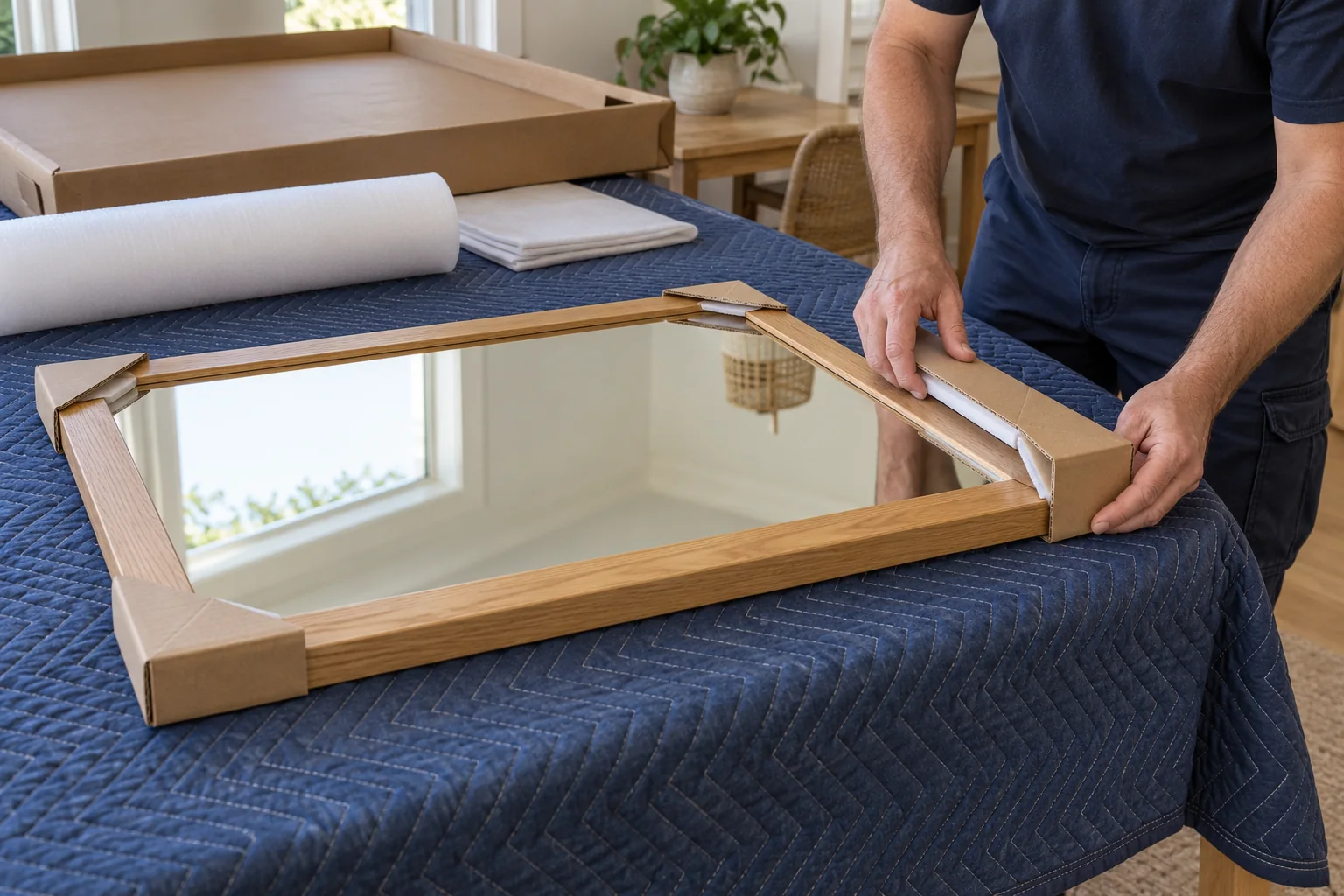
A sound, plain frame may suit padded corner protection and a suitable mirror carton, with the glass faces protected from contact. The support needs to suit the structure. Ornate mouldings should not be treated as strong lifting points, and exposed glass edges need a different assessment from a broad timber frame.
The Canadian Conservation Institute’s guidance on protective packaging explains why contact materials and support must suit delicate surfaces. This is especially relevant when an antique frame, old repair or fragile finish needs specialist advice.
Keep ordinary packing tape off the mirror and its frame. An X of tape is not a substitute for cushioning and outer protection. Any specialist protective film needs to be appropriate for the particular surface; do not copy a treatment intended for another type of glass or artwork.
During preparation, a mirror needs stable, appropriate support and a clear working area. The image below shows corner protection being fitted on a padded bench. It does not show a finished transport package or establish the mirror’s travel position.
Check the route after allowing for the packaging
The packed item is larger than the bare TV or mirror. Record doorway openings, narrow hallways, stair turns and lift dimensions where they may affect collection or delivery. A screen that came upstairs before a renovation may face a different route today.
For a Brisbane raised home, our high-set home furniture access guide helps you document stairs and landings. Elsewhere, the same enquiry still needs the actual property details. Do not unwrap an item at a tight corner just to make an unassessed carry possible.
Before the visit, resolve these practical points:
- Who supplies the packaging, who completes it and when is that work booked?
- Are wall removal, stand preparation or specialist handling included in the written scope?
- Where will the prepared package wait in a dry, stable position, clear of household traffic?
- Which accessories package belongs to it, and who checks the inventory at each end?
- Has anything changed about the item, access, receiving date or storage requirement?
Ask the transport team to determine loading and restraint for the actual package and vehicle. A blanket between a television and another piece of furniture does not establish a complete protection plan. Labels help identify handling needs, but cannot compensate for unsuitable packaging or loading.
Read the current IRCO service terms and confirm the accepted items and agreed tasks. Do not assume professional packing includes insurance. If arranging separate transit cover, ask the insurer about the particular goods, who packs them, any storage and the evidence they require.
Plan the receiving end before the package arrives
Tell the receiving person where TV1 and M1 belong, which accessories travel with them and whether unpacking is booked. Have a suitable clear area ready. A removalist delivering the package, a packer opening it and a technician installing the item may be three different arrangements.
Check the package condition and inventory at delivery. Record visible damage or missing components promptly, without moving a potentially damaged glass item unnecessarily. Arrange safe unpacking with suitable help, follow the television’s setup instructions and retain relevant packaging and photographs if there is a concern.
Do not choose a universal “wait this many hours” rule for every television. Follow its manufacturer’s advice about the environment and use after transport. If moisture, damage or a fault is suspected, seek appropriate advice before powering it on.
For a gap between addresses, discuss storage between interstate homes before the packing method is finalised. Include expected storage time, transfer stages and the intended unpacking point. Keep the item code and accessories list with the booking so the final delivery remains easy to identify.
If other fragile goods also need help, our partial-packing guide for kitchens and fragile items helps you define that wider scope. One clear enquiry can separate the everyday cartons from the pieces needing individual attention.
Prepare your TV and mirror moving enquiry
Fill in the details you know and mark anything uncertain as provisional. Build a summary, then copy it into your IRCO quote enquiry. This tool does not send a booking or confirm availability.
Moving televisions and mirrors: practical questions
Can I move a television without its original box?
Yes, a suitable replacement packaging system may be an option. Give IRCO the exact model, dimensions, condition and any packaging already available. Have the carton, inserts and protection assessed together before collection. A loose blanket or a box selected only by the screen’s advertised diagonal size is not a complete packing plan.
Can a flat-screen TV travel lying down?
Plan upright transport in suitable packaging and follow the handling instructions for the exact model. Do not lay the television flat just to fit it into a vehicle. Brief bench positioning allowed by some assembly instructions does not establish that the same position is suitable for road transport.
What size replacement TV moving box do I need?
Check the television’s actual width, height, depth and weight, with the stand or brackets in the configuration specified for packing. Compare these with the carton and insert system’s limits, including the room required for protection. The advertised screen size is a diagonal measurement and is not enough on its own.
Is bubble wrap enough to protect a TV during an interstate move?
Bubble wrap alone does not provide the fitted support and outer protection needed for a complete transport package. Screen-contact materials must also suit the model. Ask for an assessed combination of surface protection, supports and a suitable carton or specialist enclosure, with no pressure applied to the display.
Do OLED and curved TVs need different packing?
They can need different support and handling from another television of the same advertised size. Supply the exact model and its instructions, and identify unusually thin panels, curves, separate control units or projecting parts. Confirm the replacement packaging suits that design instead of assuming a universal TV box will fit.
Will IRCO take my TV off its wall mount?
Raise wall removal when enquiring and confirm who will perform it, when it will happen and whether it is included in the agreed service. Wall brackets, concealed cables and installation work may need a separate suitable technician. Do not assume a transport booking includes unmounting or installation at the new address.
Should I remove the TV stand before moving?
Follow the model instructions and the assessed packaging arrangement. If removal is required, agree who will do it and how the television will be supported during that work. Keep the correct stand, feet and labelled fittings together, and record the accessories package on the inventory.
How do I pack a large mirror without a box?
Arrange suitable mirror packaging before transport rather than relying on a blanket alone. Describe the dimensions, frame, backing, edges, condition and mounting method. A framed mirror may suit a protective carton system; frameless, ornate, heavy or damaged pieces may need specialist assessment and a different support arrangement.
Should I put an X of tape on a mirror?
Do not apply ordinary packing tape directly to the mirror or frame. A tape pattern does not replace cushioning, support or a protective enclosure. Coatings and finishes differ, so any specialist protective film should be selected for that item by the packer or conservator, rather than treated as a universal household step.
Can a wardrobe mirror travel with the flat-pack panels?
Tell IRCO whether the mirror is bonded to a door, removable, framed or part of a sliding-door assembly. It needs a component-specific packing and handling decision. Do not assume it can be stacked with plain panels, separated from its backing or removed from the furniture without assessment.
Can a boxed TV or mirror go into storage before delivery?
Include the storage stage when the packaging is assessed. Explain the expected duration, possible transfers and who will unpack the item. Confirm appropriate placement and protection, and keep the item code linked to its accessories. Suitable packaging for one handling stage does not automatically cover every storage arrangement.
What should I check when the TV or mirror is delivered?
Compare the packages and accessories with the inventory and record visible packaging damage promptly. Arrange unpacking on a clear, suitable surface with appropriate help. Follow the TV manufacturer’s setup instructions before testing, and report concerns with photographs. Keep relevant packaging and records while any issue is being assessed.
Talk through your move with IRCO
Include these items in your furniture transport enquiry and identify the fragile-item packing help you would like assessed. For a whole household, we can discuss how the preparation fits your interstate moving service.
Request a quote from Interstate Removalists Co with the details you have, or call 0417 918 451. You can find more practical planning help in our interstate moving guides.