Moving flat-pack furniture interstate: dismantle, move assembled or replace?
Wondering whether to take the wardrobe apart or leave the desk assembled? Start with its condition, how it was built and the space it needs to pass through.
This guide helps you choose a practical approach, keep the right parts together and compare moving with replacing—before you reach for the Allen key.
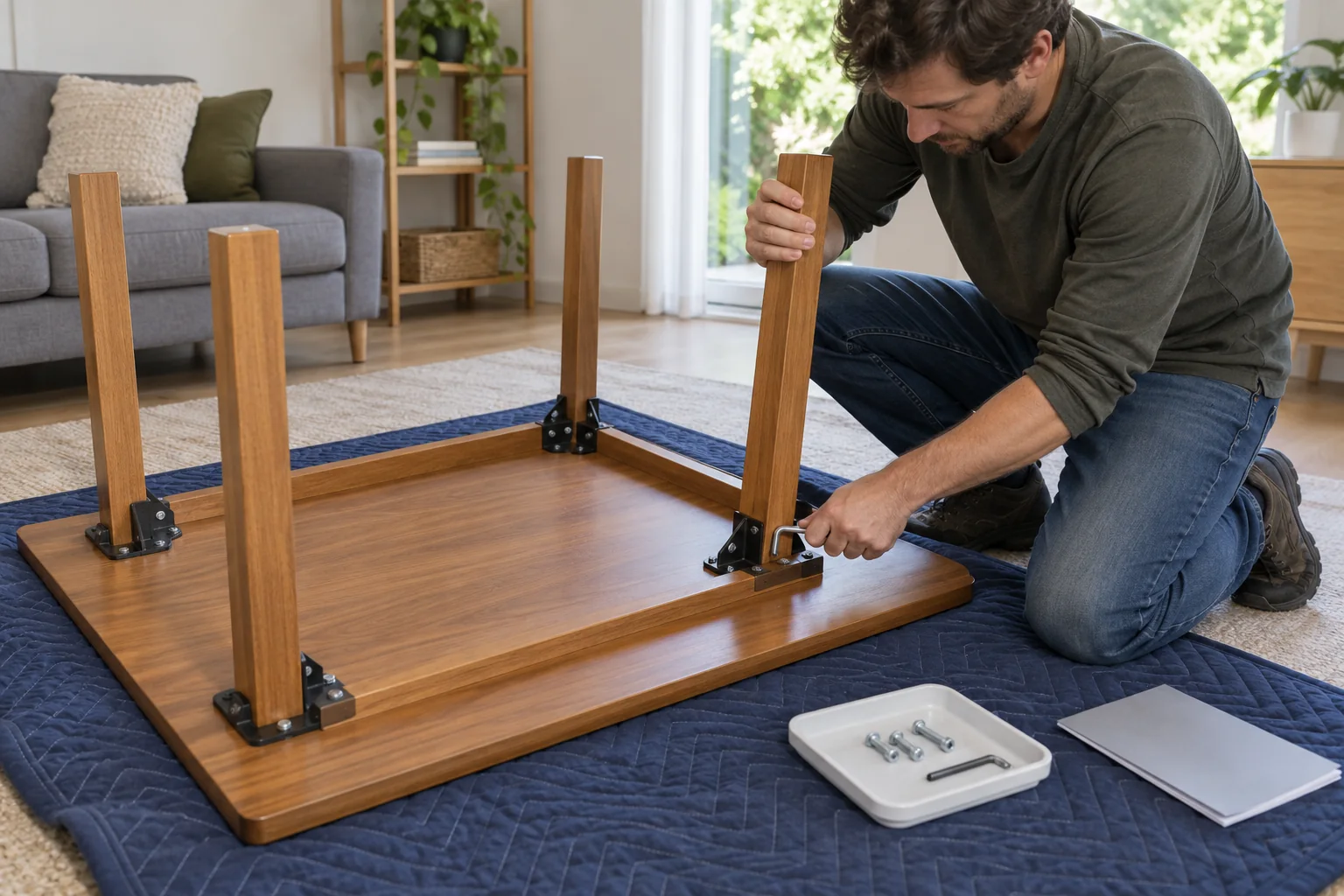
Keep it assembled, partly dismantle it or replace it?
Flat-pack describes how furniture was supplied, not how it should travel on its next move. A sound cabinet, a bolted bed frame and a wardrobe with swollen panels need different decisions. The useful question is what this particular item can handle, through these two properties, for a sensible total cost.
Start with photographs, the product name or model, assembled dimensions and any existing damage. Send those details to Interstate Removalists Co before taking it apart. We can assess the proposed interstate furniture transport and the help you would like included.
| Option | Worth assessing when | Check before deciding |
|---|---|---|
| Move assembled | The unit is sound, manageable and can pass through the access route without forcing or twisting. | Weight, joint condition, loose shelves, glass and the handling plan. Empty the contents first. |
| Partly dismantle | Removing designed-to-detach legs, bed rails or another section resolves access or handling. | Which parts are reversible, whether the remaining structure stays stable and how fittings will be kept together. |
| Fully dismantle | The construction permits it, access requires it and reassembly remains practical. | Manual, joint condition, panel protection, complete hardware and assembly time at the destination. |
| Repair, pass on or replace | Damage, poor fit or the complete cost makes keeping it less useful. | Repair feasibility, real transport savings, replacement availability, delivery, assembly and responsible disposal. |
These are assessment prompts, not an instruction to dismantle every wardrobe or discard inexpensive furniture. A well-kept piece that suits your new home may be worth taking. A damaged one deserves an honest discussion before it occupies space in the truck.
Look at the joints and panels before loosening anything
Take clear photos of corners, backing, feet, hinges and connections. Note loose joints, stripped holes, bowing, missing fittings, water damage or a unit that leans. Explain whether it has been dismantled before and whether anything was repaired or glued.
Chipboard, MDF, plywood and solid timber do not all behave the same, and the material alone does not settle the decision. The condition of the fixing points and the way the item is built matter. A screw that no longer grips or a damaged panel edge may need attention before the item can be moved and rebuilt reliably.
- Bolts and designed removable connections: check the instructions to identify what can be released and in what order.
- Cam fittings and dowels: identify the exact arrangement. Do not force a panel simply because a visible screw has been loosened.
- Glued joints or fixed backing: do not assume they can be reversed without damage. Ask for an assessment if dismantling depends on removing them.
- Wall attachments: keep them in place until the furniture is ready to be safely supported and moved under an agreed plan.
Photographs create a useful condition record and help the office ask better questions. They do not replace an on-site assessment where a structure is unstable or its fixings are hidden. Point out concerns before collection, while there is time to choose another approach.
Check the new room as carefully as the front door
Record assembled height, width and depth, then measure the clear openings and turns along the route at both properties. Include stair landings, lift dimensions, ceiling restrictions and the space needed to handle the item. Allow for protective wrapping rather than relying on a paper-thin clearance.
If it will be rebuilt in the new bedroom, check the room layout and the manufacturer’s assembly clearance. Some units need space to be assembled in a particular position before they are raised or placed. Furniture that fits its final wall may still need more working space to get there.
A useful enquiry says, for example: “Two-door wardrobe, model supplied, currently assembled upstairs; narrow landing at pickup; ground-floor bedroom at delivery; photos and measurements attached.” That gives the team more to work with than “one flat-pack wardrobe”.
For a whole household, add these item-specific details to your interstate moving plan. For just a bed, desk and cartons, use the small furniture move checklist to keep the inventory complete.
Three everyday examples—and the detail that changes the decision
A bolted bed frame
The frame cannot pass through the bedroom door as one piece. If the design allows the rails to be removed, partial dismantling may solve the problem. Count the headboard, footboard, rails, slats and fittings as one labelled set.
A sound low cabinet
The empty cabinet fits the access route and its joints are sound. Moving it assembled may avoid unnecessary dismantling. Loose shelves, doors and glass still need an agreed preparation and protection plan.
A wardrobe with swollen edges
The lower panels have water damage and some fittings no longer hold firmly. Send close-up photos before booking. Repair or replacement may be more practical than expecting wrapping to restore the structure.
Use these examples to frame the conversation, then choose the method around your furniture’s construction, condition and access.
If dismantling is needed, make reassembly part of the same job
Find the exact instructions first
Use the product name, article number or model label to locate the correct documents. A similar-looking wardrobe may have different connectors. IKEA explains how to find its assembly instructions; retain a copy with the inventory.
IKEA’s disassembly guidance points customers towards the assembly sequence but does not provide a universal dismantling method. Check that the actual joints can be released. Stop if a part is glued, damaged, loaded or unsupported rather than forcing the next step.
Photograph, identify and group the components
- Photograph before starting. Capture the complete piece, each connection and the position of fittings. Give the item a unique inventory number.
- Agree how much will come apart. Remove only the sections needed under the planned method. Arrange enough people and working space to support the pieces throughout.
- Group hardware by item and stage. Use sealed, labelled bags for the appropriate bolts, brackets and other removable fixings. Keep different furniture sets separate.
- Protect and identify every component. Put labels on protective wrapping or tags that will not damage the finish. Keep orientation notes and photos where the person rebuilding it can find them.
- Count the set before collection. Record the panels, rails, shelves, doors and fittings package. Tell the office about anything missing before it is needed at delivery.
Follow the product instructions on which connectors remain fitted and which come out. Pulling every dowel or fixing from every panel can create extra work and damage. Equally, a protruding connector needs protection so it cannot mark the neighbouring piece.
For IKEA products, its spare-parts service can help you check replacement fittings. Identify the correct part and availability before assuming the item can be rebuilt on arrival.
Protect panel faces, corners and the fittings that finish the job
Once dismantled, broad panels and exposed edges need their own packing plan. Keep clean protective material between finished surfaces and protect corners. For temporary preparation, keep components low, stable and fully supported; do not leave tall panels leaning where they can fall.
Make the package identifiable without sticking tape directly to a decorative finish. A label such as “W1 wardrobe — left side — bedroom 2” is more useful than “wood”. Put the matching hardware into a secure, labelled accessories box and record whether it travels with the load or with you.
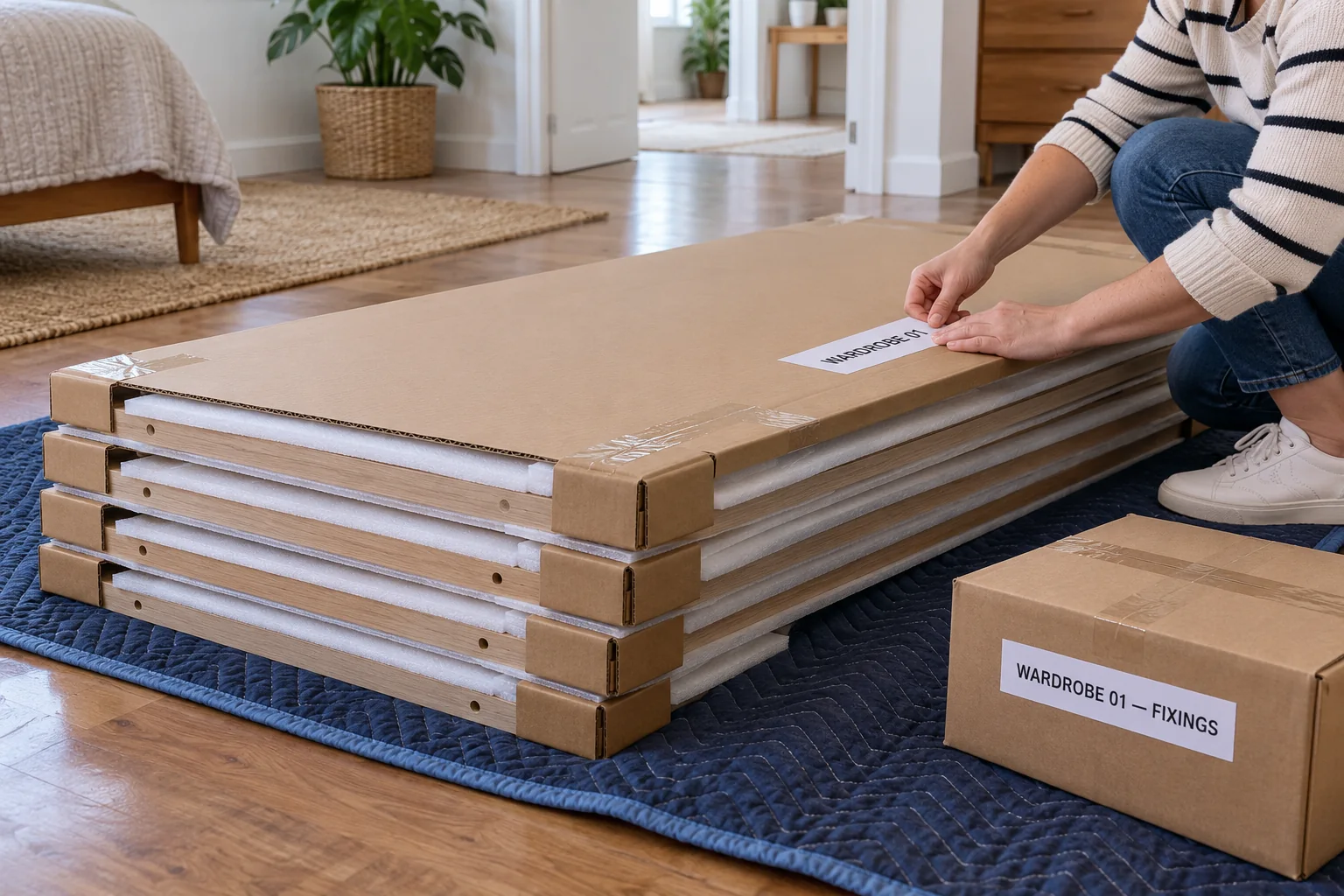
Do not treat stretch wrap alone as protection against a hard edge or use tight strapping directly on vulnerable panels. The loading and restraint arrangement needs to suit the furniture and vehicle. Tell IRCO about glass doors, mirrors, thin backing sheets and long unsupported components so their handling can be assessed.
For mirrored doors and other large fragile pieces, our mirror protection and replacement-packaging guide explains the information needed for an individual assessment. State whether the glass is bonded, framed or removable so its support is considered separately from plain furniture panels.
If you would like help with wrapping or fragile components, request packing and furniture protection for those specific items. Clear scope avoids both a missing task and paying for preparation you have already completed.
Compare the actual cost of keeping it with the cost of replacing it
The original purchase price is useful background, but it is not the only figure that matters now. Ask for the move to be quoted with the item included and, where practical, without it. The difference is the transport saving you can actually use in the decision.
A smaller volume does not always reduce the total if a service minimum still applies. Likewise, flattening a wardrobe may save space while adding dismantling, packing and assembly work. Compare the same addresses, dates and service level.
| Keeping this item | Replacing this item | Question to resolve |
|---|---|---|
| Difference between the move quote with and without it | Purchase price of a suitable replacement | Does removing it change the move price, and does the replacement actually fit? |
| Dismantling, protection, repair and reassembly not already included | Delivery, room placement, assembly and disposal or collection costs | Are any costs missing or counted twice? |
| Condition, quality, remaining usefulness and personal value | Availability, delivery lead time and time spent choosing and setting up | Which option leaves you with usable furniture when you need it? |
For illustration only: if an otherwise identical move is quoted at $2,400 with a desk and $2,340 without it, leaving the desk saves $60 in transport. Those invented figures show the comparison method; they are not IRCO prices. Any extra preparation or assembly costs still belong in the calculation.
Keeping serviceable furniture can make sense even when it was inexpensive. If you decide against moving it, allow time for a suitable donation, resale or disposal arrangement. Do not leave that decision until the collection crew arrives.
Reassembly and anchoring at the destination
Request dismantling and reassembly at booking, naming the items and tasks. IRCO’s terms and conditions state that these services need to be requested and attract additional charges. Have the agreed work listed in the quote; transporting furniture does not by itself include rebuilding it.
For a commercial desk or workstation delivery, the office furniture installation and assembly service explains that broader setup work. For household pieces, describe your particular requirements so the office can confirm what is available.
Before a rebuilt item is used, check that the correct components and fittings are present and the assembly follows its instructions. A missing structural fixing is a reason to pause, not something to conceal by loading the shelves.
Plan anchoring before the move for furniture that needs it. The ACCC’s toppling furniture guide explains why securing furniture matters. The correct fixing depends on the furniture and the new wall or floor. Arrange competent help where needed, and discuss the work with the landlord or agent if you rent.
Wall fixing is a separate task to furniture assembly and must be agreed explicitly. Keep children away from unsecured furniture while setup is incomplete. A clear delivery plan should leave you knowing which items are ready to use and which still need work.
Prepare your flat-pack furniture moving enquiry
Fill in the details you know and mark anything uncertain as provisional. Build a summary, then copy it into your IRCO quote enquiry. This tool does not send a booking or confirm availability.
Flat-pack furniture moving questions
Can you move IKEA and other flat-pack furniture interstate?
It can be assessed for transport, but the method depends on the item’s construction, condition and access. Send the model, dimensions, photos and any damage or previous repairs. Some pieces can travel assembled, some need partial or full dismantling, and others need repair or a different plan before moving.
Should I dismantle flat-pack furniture before the removalists arrive?
Agree the method first. Check the exact product instructions, joints and access route, then confirm who will do any dismantling. Taking everything apart without a plan can create damaged panels, missing fittings and extra reassembly work. If you want IRCO to assess additional assistance, request it at booking.
Is it cheaper to move furniture assembled or dismantled?
Compare the complete quoted options. Dismantling may reduce space but add labour, protective packing and reassembly. Moving assembled can require more handling or unsuitable access. A service minimum can also limit the saving from reduced volume, so do not assume that flat always means cheaper.
Does a flat-pack wardrobe have to be taken apart for moving?
Not automatically. Assess its size, stability, construction and the route through both properties. A large wardrobe may need dismantling for access, but glued joints, damaged panels or worn fittings can make that difficult. Provide photos and the model before deciding how it should travel.
Can I leave clothes or other belongings in drawers?
Empty the furniture contents for the preparation assessment and pack them separately. Loaded drawers add weight and can affect handling. Ask how the drawers themselves, shelves and doors should be secured or separately protected for that particular item rather than removing or retaining every component by default.
What should I do if bolts or furniture fittings are missing?
Identify the product and correct part using the instructions or manufacturer’s assistance. Check availability before the move and tell the office what is missing. Do not substitute an unsuitable fixing or assume a structurally incomplete piece can be safely assembled and used at delivery.
How should I label dismantled furniture parts?
Give the whole item an inventory code, then identify components and their destination room on protective wrapping or suitable tags. Keep hardware in sealed, labelled bags grouped by item and stage. Record the fittings package on the inventory and retain photographs of the original connections.
Can glued flat-pack furniture be dismantled?
Do not assume a glued joint is reversible. Forcing it apart can damage the panels or connection. Explain any glue, repairs and fixed backing before the handling assessment. Moving assembled, partial dismantling, repair or replacement may need to be considered depending on condition and access.
Is furniture reassembly included in an interstate removal quote?
Only when it is expressly included in the agreed scope. IRCO’s terms require assembly or dismantling to be requested at booking, with additional charges applying. Name the items, provide instructions and photos, and confirm the tasks at each property before treating reassembly as booked.
Will the furniture be anchored to the wall after assembly?
Wall anchoring is a separate task that must be agreed. The correct fixing depends on the furniture and the destination wall or floor. Follow the manufacturer’s safety instructions, arrange appropriate help and keep furniture that needs anchoring out of use until setup is complete.
How do I decide whether to move or replace a flat-pack item?
Compare the actual difference between moving quotes with and without the item, plus preparation, repair and assembly costs not already included. Compare that with a suitable replacement’s purchase, delivery, setup and disposal costs. Include condition, usefulness, availability and personal value before deciding.
Can dismantled furniture travel in a shared interstate backload?
Ask the office to assess the complete packaged inventory against suitable route capacity and dates. Panels and hardware still need clear identification, appropriate protection and an agreed handling plan. List every component set and confirm any dismantling or assembly separately; a smaller package does not guarantee a lower total price.
Talk through your move with IRCO
Start with interstate furniture transport for the item assessment, or discuss available backloading options if your dates are flexible. Include the condition, preparation and requested assembly work with either enquiry.
Request a quote from Interstate Removalists Co with the details you have, or call 0417 918 451. You can find more practical planning help in our interstate moving guides.