Moving existing furniture
Relocate desks, chairs, cabinets and shared furniture between business premises or departments. Identify the items staying, moving elsewhere or needing separate collection, so the furniture removal matches your new layout.
Business deliveries · Office furniture · Fitouts
Keep your next delivery, office refresh or interstate project moving with a clear plan. Interstate Removalists Co helps businesses arrange commercial furniture removals and transport across Australia, from a few important pieces to bulk furniture deliveries.
Tell us what needs moving, where it needs to go and what must happen at delivery. We’ll help you work through access, timing, protection and any placement or assembly you require.
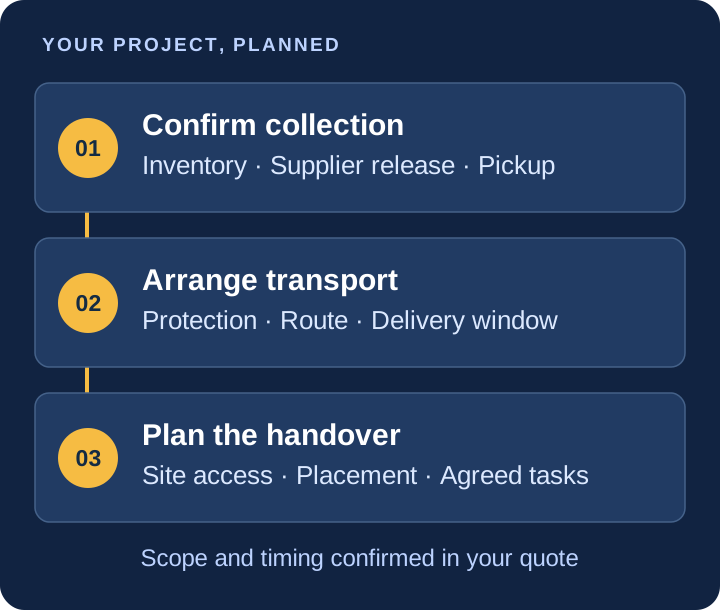
Furniture moving is often one part of a bigger job. A supplier needs stock collected, a facilities manager needs an office ready for staff, or a fitout coordinator needs the right items delivered in sequence. We work with offices, suppliers, facilities teams, property managers, procurement teams and fitout coordinators who need those details considered together.
When you’re organising commercial furniture delivery, you’re balancing timelines with building rules, access constraints, and people on-site. Interstate Removalists Co works Australia-wide with businesses that need commercial furniture moved properly — not just “delivered”. Whether it’s a supplier pickup, a staged fitout drop, or an internal relocation between floors, we aim to reduce friction and keep your project moving.
Relocate desks, chairs, cabinets and shared furniture between business premises or departments. Identify the items staying, moving elsewhere or needing separate collection, so the furniture removal matches your new layout.
Arrange business furniture delivery from a supplier, showroom or warehouse to your receiving site. Include the order reference, release contact, packaged dimensions and the date the complete order will be ready.
Plan a workstation rollout, reception refresh or multi-site furniture delivery around access and installation dates. Explain the sequence for each floor or location and which deliveries depend on other work being finished.
If your project requires deliveries going directly into work areas (not just kerbside drop-offs), our office furniture delivery and placement approach is designed for real commercial sites — getting items to the right floor, the right room, and the right position so your team can get back to work faster. For larger transitions and staged changes, we also support office relocations for businesses where downtime reduction is the priority.
If the job includes assembly and finishing work, our furniture installations and assembly service helps businesses take delivery all the way through to set-up — especially useful for workstation rollouts, boardrooms, and fitout timelines where everything needs to land ready-to-use. It’s a cleaner handover, fewer contractors, and a smoother end result.
These services can form part of the same project, but the scope needs to be agreed. A furniture transport quote should clearly identify collection, delivery, placement, assembly and any storage required. Use the specialist pages above when you need more detail on one part of the job.
If you are deciding between a packaged shipment and individual furniture handling, our guide to pallet freight versus office furniture removalists compares preparation, unloading, room placement and the complete delivery cost. It helps you specify the right scope before requesting a commercial furniture quote.
Commercial sites include a mix of heavy, awkward, fragile and high-visibility items — and each one needs the right handling. Our office furniture transport service covers everyday essentials (desks, chairs, filing cabinets), plus higher-risk items that can’t be “bumped and hoped for” (boardroom tables, reception counters, glass components, modular systems and cabinetry). If you’re ordering from a supplier or coordinating an internal move, Interstate Removalists Co supports office furniture delivery service requirements including multi-drop schedules, building access constraints and staged delivery.
We regularly assist with workstation rollouts and workstation delivery and setup-style projects where the priority is getting stock to site in the correct sequence. When you’re coordinating commercial furniture logistics, it’s not just “move A to B” — it’s getting the right pieces to the right floor, at the right time, with the site still safe and functional.
“Twenty desks” could mean twenty assembled workstations or flat-packed tops and frames with separate screens, cable trays and pedestals. List each component and explain how it is packaged. For chairs, say whether they stack or arrive individually boxed. For large tables, provide the assembled size and whether the top separates from the base.
Photographs help explain finishes, awkward shapes and access, while measurements help assess vehicle space and handling. If your project includes furniture, fixtures and equipment (FF&E), identify each item rather than assuming that a broad FF&E description covers specialist equipment, building works or every fitting on site.
A commercial delivery can be perfectly packed and still run into difficulty if access is unclear. A blocked loading zone, unbooked dock, small lift or restricted basement can change the handling plan. Include access at the collection point as well as the receiving building, so those constraints can be considered before transport is confirmed.
We’ll ask the practical questions early: Where can the truck park? Is there a loading dock? Are there stairs? How many levels? Is there a lift, and does it need booking? Are there site rules, inductions, or after-hours access requirements? This helps us lock in realistic delivery windows and avoids the dreaded “turn up and hope” approach.
We work around building access, lift bookings and loading zones to hit realistic delivery slots. Ideal for fitout timelines, supplier drops and after-hours commercial furniture delivery.
Commercial furniture transport with the right protection — wrapping, blankets, edge guards and strapping. Designed to reduce damage risk for desks, workstations, boardroom tables and reception furniture.
Clear planning for stairs, corridors, dock access and floor-by-floor staging — including multi-site office furniture delivery. A practical process that keeps your team moving and your project on schedule.
Check these details with the building manager or site contact:
A reserved lift is only useful if the furniture fits and the booking covers the unloading and carrying time. Measure the largest pieces against the full route. For a difficult item, send photographs before booking so the handling method can be assessed without relying on a last-minute solution.
Commercial furniture delivery can finish at several different points. Specify your required handover when requesting a quote, especially if procurement staff are booking for a site they do not manage day to day.
Confirm the unloading location and who will take responsibility from there. A dock or ground-floor handover requires different arrangements from carrying furniture to a workstation on an upper floor.
Identify the floor, room and furniture positions. Supply a labelled floor plan where useful, with someone available to resolve questions. Confirm whether unpacking and packaging collection are included.
List the products, models and tasks required, including any dismantling at pickup. Confirm suitability, tools, instructions and the responsible trades for fixed installations or electrical connections.
Need extra packaging help? Our Packing / protection options page covers the most common support needs for commercial jobs, from cartons to protective materials. For sensitive projects, we can also align the work to a premium “white glove furniture delivery” style outcome — careful handling, controlled placement, and reduced risk on-site.
Make that description practical: ask for the handling, unpacking, room placement, assembly and packaging tasks to be stated separately. Confirm what applies to your project and how the furniture will be handed over. The label alone should not be used to assume every finishing task is included.
If you’ve ever received brand-new furniture with scuffs or edge damage, you already know why protection matters. We use a protection-first approach for furniture transport with blankets and straps because commercial furniture is often high value, high visibility, and difficult to repair. Our team uses suitable wrapping, padded protection, and proper strapping so loads stay stable and surfaces stay clean — particularly for boardrooms, reception areas, executive desks, and anything with glass, laminate or veneer finishes.
Start with an accurate inventory and note any existing marks or loose components before collection. Keep model references, labelled fixings and installation instructions with the relevant furniture. Tell us about delicate finishes or manufacturer-specific preparation requirements so the proposed packing and handling can account for them.
For new stock, confirm whether the supplier is releasing boxed, wrapped, crated or loose furniture. If the packaging is damaged or an order is incomplete, identify who can approve collection or a revised plan. Our packing advice is a useful starting point for preparation, with packing assistance available to discuss for the items that need more attention.
At delivery, have the receiving contact check quantities and note any concerns against the agreed inventory or delivery paperwork. Ask before booking what transit protection applies, what exclusions exist and how a concern should be reported. Keep photographs and order details together so any follow-up relates to clearly identified items.
Fitouts and commercial projects rarely run 9–5. There are tradies on-site, schedules shift, and access is often limited to a specific slot. That’s why we build our service around timed delivery windows for fitouts and sensible sequencing. If you need furniture delivered before staff arrive, staged for a floor-by-floor rollout, or coordinated across multiple addresses, Interstate Removalists Co can plan a delivery run that matches your project timeline and reduces site congestion.
For facilities teams and property managers, staged deliveries improve safety and flow. For procurement teams managing suppliers, staged drops reduce the risk of “everything arrives at once” chaos. This is where commercial furniture logistics becomes a real advantage — you’re not just transporting items, you’re supporting a functioning site.
Share your preferred sequence early, then confirm the available transport and site windows. A staged delivery may mean different floors on different days, separate branches receiving their own allocations, or priority items arriving before the rest. Each stage needs its own furniture list, receiving contact and clear completion point.
Ask suppliers when the complete order will be released and identify any split shipments. If one item is late, decide whether the other goods should travel or wait. Confirm who may approve additional collections, waiting time or a revised delivery date, and how the price changes will be handled.
If a fitout or handover is delayed, discuss storage and later delivery before collection. Confirm the storage arrangement, access to individual items, handling charges and redelivery costs. This is particularly useful when the installation team cannot accept a full delivery or there is limited space to hold furniture on site.
These illustrative examples show the information worth including. Your transport options and quote will depend on the actual project.
List the twelve desks, chairs, screens and pedestals separately. Say whether the new furniture is assembled, where it will be placed and what happens to the old pieces. Include lift hours and whether staff will be working nearby. This makes it easier to assess delivery, assembly and any separate furniture removal.
Provide one master inventory with the allocation for each branch. Confirm when the supplier can release the order, each branch’s receiving hours and the contact for every stop. Label items by destination before loading and agree how each delivery will be confirmed.
Describe the table top, base, chairs and storage furniture, including dimensions and delicate surfaces. Confirm the destination room, lift clearances and who will assemble the table. Flag the meeting or opening date, then agree a delivery window that allows time for the remaining setup.
For commercial furniture moving between states, give the full collection and delivery postcodes and every planned stop. Name any fixed opening date, lease handover or installation appointment. Transport timing needs to be considered alongside those commitments, especially when different people control the supplier release and receiving premises.
For relocations across states, interstate commercial furniture transport also depends on distance, lane availability, and how tightly the dates need to be locked in. That’s why we recommend getting a quote early — especially if you’re coordinating installers, building managers, or handover deadlines.
Ask whether a dedicated journey or available shared space suits the consignment. For a smaller load, backloading may be worth comparing when the route and timing are suitable. Check the collection and delivery windows, handling arrangements and total quote; shared capacity does not automatically suit a tightly booked commercial site.
For location planning, browse our state-to-state moving locations. Our interstate moving guide and East Coast moving information offer broader context. Confirm the service available for your addresses rather than assuming that a listed city establishes a scheduled delivery run.
The fastest way to price commercial furniture transport is to focus on what actually affects time and risk: the volume of items, access conditions (stairs, lifts, distance to carry), pickup and drop-off requirements (dock bookings, security check-in), and whether you need strict delivery timing. For bigger projects, bulk office furniture transport and multi-site office furniture delivery will also depend on how you want to stage the run — all at once, or broken into practical drops.
Request a written quote that identifies the load, addresses, access assumptions and agreed service. If you are comparing commercial furniture movers, send each provider the same brief so you can compare the total work involved.
A low headline price can cover a different service from the one your site needs. Ask whether the amount covers delivery to the dock or placement upstairs, and whether the furniture will arrive assembled. If work is charged by time, confirm the crew size, billing increment and when charging starts and finishes.
Useful detail saves follow-up: send a furniture list, access photographs and a simple floor plan together. Mark estimates clearly, identify the details still awaiting confirmation, and update the brief when the load or site arrangements change.
Include these details in your commercial furniture transport enquiry. For a wider household or mixed furniture consignment, see our furniture transporting services. If you are organising the surrounding move as well, our moving preparation guide, removalist service guide and services directory provide further information.
Yes, you can enquire about a small consignment as well as a bulk delivery. List the pieces, dimensions and addresses, then ask about the available options and minimum charges. Tell us if your delivery must fit a particular building or supplier appointment.
Include the supplier’s address, order reference, collection contact and confirmed release date. Explain whether the goods are boxed, palletised or loose, and what loading facilities are available. The collection needs to match the supplier’s release requirements and your delivery plan.
Assembly should be specified and agreed separately. Identify the furniture models, instructions, parts and tasks required. Confirm dismantling at pickup, reassembly at delivery and responsibility for any fixed installation or trade work before accepting the quote.
Ask about the available options for your route and date. Confirm building access, security, lifts and a receiving contact for the same window. Include any after-hours requirements in the first enquiry so availability and pricing can be assessed.
Provide a separate inventory allocation, address and contact for each destination. Explain the preferred delivery order and the time windows at each site. The quote can then be assessed for the complete run and any additional handling between stops.
Contact the coordinator as soon as you know. Ask about revised dates or storage arrangements and confirm any waiting, handling or redelivery costs. Do not assume the original booking includes an extended hold or unrestricted access to stored furniture.
Describe what needs removing and its intended destination before booking. Separate transport for reuse, storage or another site from disposal requirements, and confirm what can be arranged and priced. Packaging collection should also be written into the scope if required.
This page focuses on transporting commercial furniture and coordinating its delivery. If the project also includes staff moves, equipment, records and a wider relocation programme, start with our office relocation information and describe the full scope in your enquiry.